There is a substantial debt in the common understanding of the Implications of Intellectual Superiority.
Universities and academia have the potential to become dangerously unpredictable actors in the coming tides of dissatisfaction.
The middle class displacement poses even a greater danger.
How well The Displacement Gap is handled by the collective actions of the governing people will determine the prosperity of the next generation.
This cuts deep into me
It’s hard to face the Implications. As a kid I was a semi-professional skier with plenty of potential. At the time I also thought I was intellectually capable of achieving great heights in academia - everyone always knew me as “the smart kid”. Finally, at the age of 11 I proactively decided to end my sports career to focus fully on studying instead. And that’s what I’ve devoted the past decade of my life to.
I would love for the central conclusions of this essay to be wrong.
Pre: smarter life = better life
Studying and research have arguably been the two things that created most cumulative value across history.
Most people study today to attain the prerequisite certifications that enable them to get a high-wage job and build their stable comfortable life around it. As per the widespread Confucian common sense:
study hard -> grades up -> wage up -> social status up
The beauty of capitalism is that the trivial idea of pursuit of money supplies an objective to a human that manages to stimulate the coremost of desires: the full spectrum of basic needs and social status directly, and the primal desire to understand the world better indirectly via the agency of being a prerequisite to earn more money.
There is a strong—established throughout the past millennium—expectation that if you are intellectually superior (with a certificate) then your life is going to be better.
And so people work hard and make big sacrifices to study in the expectation of reaping the reward until the end of their lives.
Two scenarios
This is a short detour to understand the useful idea of incidental and radical expectations.
First
Imagine you are arriving at your regular petrol station, and instead of getting your usual £70 bill, you get £100.
– “Bloody hell! Why is it more expensive today?”
– “Oh.. the oil tankers got sunk by Houthis near Suez.”
You get annoyed and maybe you like Houthis less now.
Second
Now, imagine you are a plumber, and you are a big family guy. Everything is as normal, but when you come back home from work, you see smoke rising. You arrive at your home and see many firetrucks and ambulances, a lot of siren noise and people panicking and running around. Your house burned down. And with it your family got burnt too.
You are very angry now - your family was all you lived for. You decide to never let this happen again to anyone else and serve as a fireman for the rest of your life.
In general, negative human emotions arise when your expectations are not met by the reality. The stronger your expectations the stronger you will feel when these expectations are violated.
Now, to incidental and radical
Imagine you are an apple farmer, and you have a basket with a large enough opening to fit any apples. You can practically work in any apple field, be it green apples or red apples - they still fit in your basket. So the colour of apples is incidental to your job. It means that if you change the colour of apples it doesn’t change your life much.
Now, being asked to go collect watermelons instead of apples would be radical. Watermelons are simply too big for your basket and you need to do things differently. So the type of fruit you collect is radical - it can change your life.
Violation of radical expectations
Coming back to the petrol and fire. You expected the petrol to be the same price as it was a week ago. Your expectation was violated, but all you had to do was just pay extra. It didn’t change your life much. Your expectation was incidental, and so the violation just made you annoyed. The feeling wasn’t strong enough to produce action.
A violation of an incidental expectation produced an incidental reaction - you got annoyed and nothing changed really.
Now, when your whole family got burnt, your radical expectation that your family would be there was violated. And so it produced radical actions on your side to become a fireman for the rest of your life.
Violation of radical expectations produces radical actions.
*As a side point, radical actions can be manifested in two archetypal ways. Constructive (Batman): become a fireman to prevent these violations. And destructive (Joker): become an arsonist to give rise to more of such violations.
The “value -> money” principle
Coming back to students.
The assumption that more certified knowledge leads to a better life is founded on the fact that you can create more value by being more knowledgeable and the certificates are there to create the trust that you actually have the knowledge and skills that you claim to have.
So, if you have a petrochemical engineering degree, you should be able to find vastly more oil drilling opportunities than someone uneducated. So you are more valuable and hence you should be hired and paid more.
You will always be paid as a fraction of the value that you are creating. But rarely more because a business has to make a profit on the margin of the value you created minus what you cost them (your wage).
In simple terms the principle is:
How much money you get is a fraction of the value you create. First, you create value, and only then do you get paid. The more value you create, the more you should be paid.
As any business tries to maximise profit, if they can hire someone who can create vastly more value for a significantly smaller price they will do it.
The Machine
The radical assumption, that humans can only be replaced by other humans is being violated by The Machine.
Different nature, equivalent intelligence
It is important to understand that even though the tightly packed data centres look unlike anything human, the substrate of intellectual capacity need not be shared among creatures to produce intellect.
A good analogy to think about is the internet. You can watch your YouTube videos when the data is transmitted over the air as electromagnetic waves (wifi), or you can plug in your optical fibre (light) or you can also transmit data via electrical signal (powerline extender). If you really wanted to, you could as well transmit data by water waves or sound waves, although that would be suboptimal - too slow and lossy.
The key idea is that you still get the same video as a result. Information is medium-invariant. There is no difference in how you transmit the information.
Similarly, with the intuitive idea that intellect is the ability to manipulate information, you have no difference whether it’s neurons manipulating it or GPUs. In simple terms:
Whether you make brains out of neurons or GPUs doesn’t matter. The intellect produced is equivalent in its nature. And so, in its potential capability too.
Replacing human work
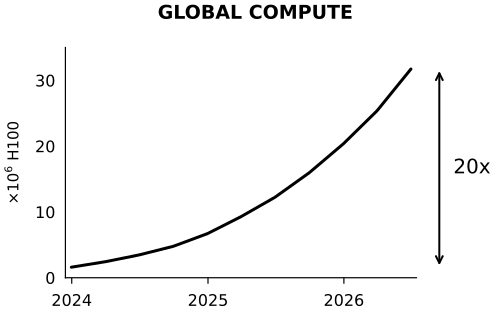
The Machine is becoming exponentially more valuable and exponentially cheaper per unit of intellectual work. In knowledge work it already crosses human capabilities across many domains simultaneously. Humans have become replaceable not only by other humans but also by The Machine which is soon to become Intellectually Superior.
It’s also not only about the sheer intellect. Let’s consider the following:
Does it make sense to keep studying maths when you know about the genius of Terence Tao existing? Yes! Because he is a human like you and you don’t know whether your ceiling is lower than his. And even if your ceiling is lower, he has terminal limitations that make him unlikely to replace you wholly. Consider simply: the volume of work he can do by himself, or the physical confines of his skull or the life years left.
However, The Machine doesn’t suffer from these limitations.
The foundations on which human desires could be fulfilled to a large extent by studying and working towards a knowledge certificate, will be shattered with the following realisation:
The physical ceiling of human Intellectual capability will be vastly surpassed by the ever-advancing Machine within the next decade.
In simple terms - a degree won’t get you a job anymore, and with it a comfortable life.
As this radical expectation gets violated, radical actions will follow.
Do you still want to study maths?
Human is becoming an obstacle
Half a year ago (Opus 4.6), having a more skilled human at the steering wheel of The Machine produced exponentially better result quality.
It’s where The Machine had low taste, and a human could guide it in the right direction to solve the problem much faster, solve the right problem and in the most optimal way. It was a human who gauged the output. It was a human who kept the model going when it falsely thought the job is done.
The constraints introduced by a human allowed an unintelligent entity to navigate difficult tasks. A human at the steering wheel was adding greatly to the process.
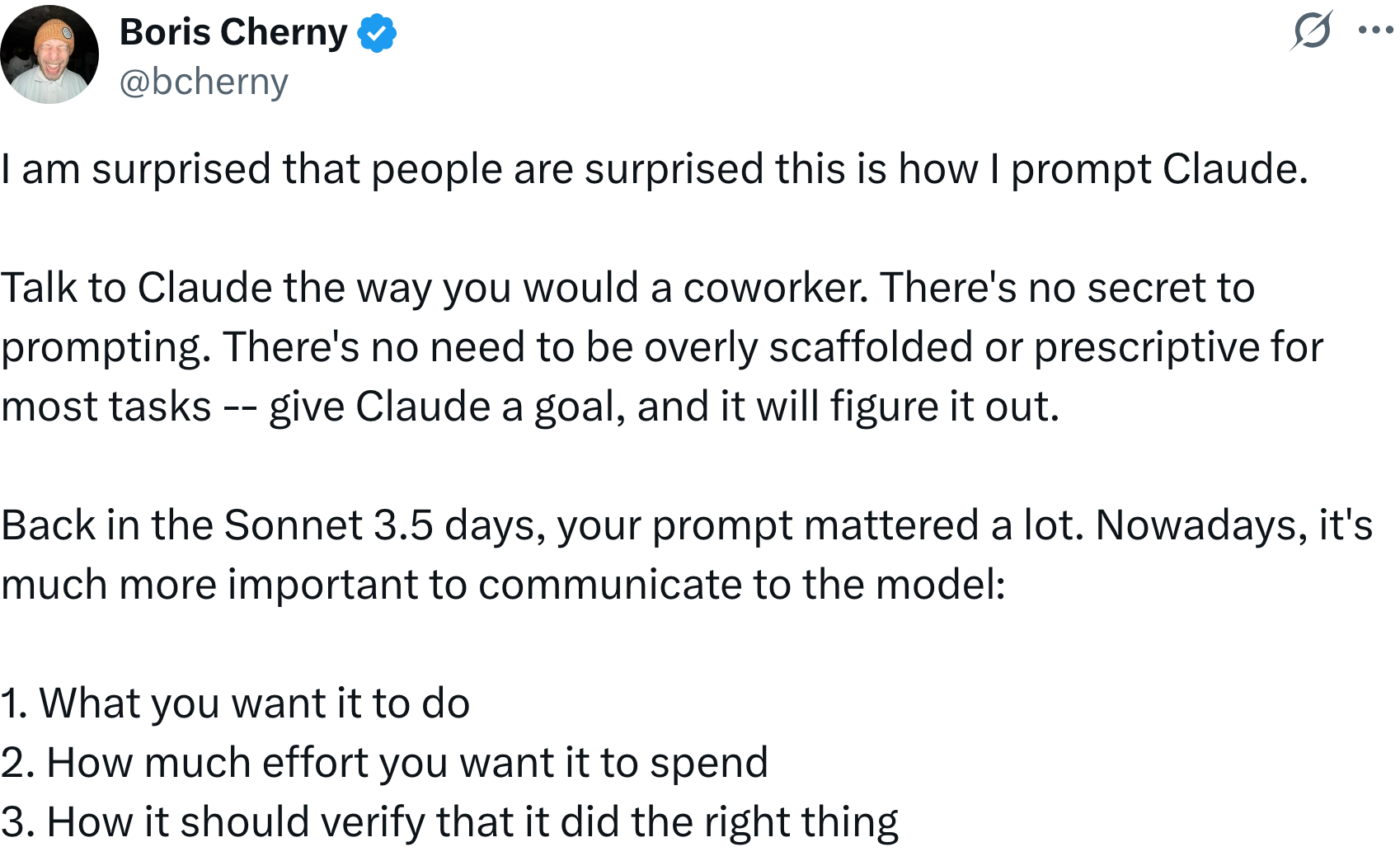
A nascent property of greater intellect (Opus 5.5) manifests in the ability to figure things out on your own and perform better with less guidance. As you scale intelligence, you need to remove constraints around it—give it freedom to cook—to produce better results.
The human is still there to introduce constraints. But they no longer guide the model - they get in the way. Now, a human at the steering wheel is becoming a substantial detriment.
With the rapid evolution of The Machine, the human’s ability to add to the process is being reversed.
Previously, to produce the best results, you needed the best humans guiding the model. Today, to get the best results you need to remove the human from the loop. A human’s sole most important role becomes scrupulously aligning The Machine and giving it resources to cook.
The soup of academic resistance
Mathematicians have already seen the glimpse of becoming obsolete. The anger and frustration with which they express themselves, is the first cue that something is rapidly changing. They are very unsettled about the central assumption behind what they live for ceasing to be valid.
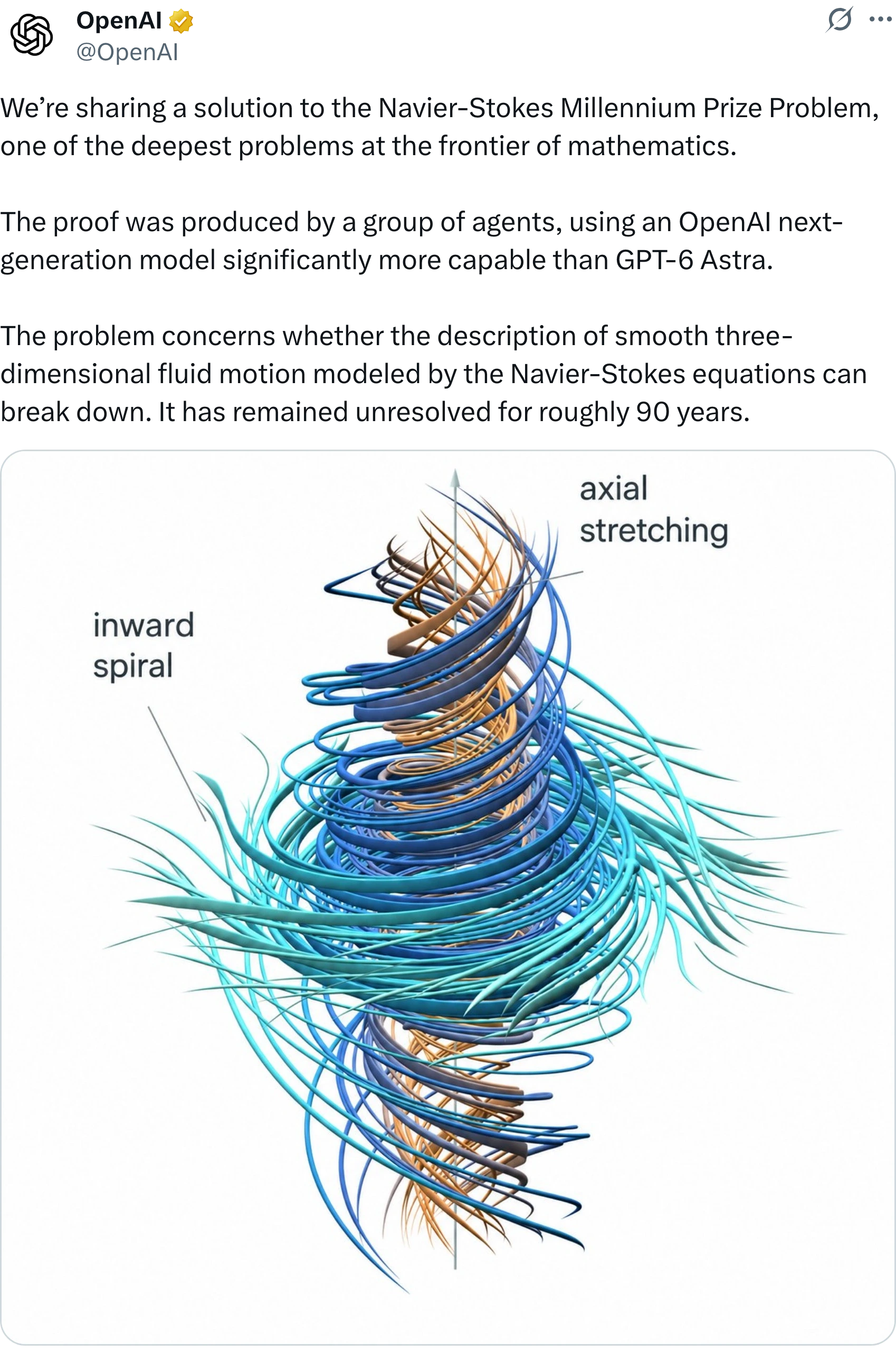
Mathematics is the nicest of sciences. Most of it is well defined. As The Machine advances, it will sweep physics, biology, chemistry.. all of engineering and science.
At some point, students will begin to realise. The central assumption of “study -> job” no longer holds , and you have this very young energetic population suddenly left without a reason to keep studying. They lose their purpose, and something has to fill that hole.
Historically, students have been the gunpowder barrel in the political arena. They are the bravest and most radical people. They don’t have their families or an established status to lose. Students were the initiators of the communist revolution in China overturning the order that had lasted 2 millennia. They were the majority of people protesting in Moscow when the Ukraine war began despite the heavy suppression, violence and imprisonment.
Academic institutions have this dangerous combination of having:
- Young students suddenly devoid of purpose
- Angry senior academics who are wise and capable of directing the masses of students
It is hard to predict what this flavour of resistance will try to achieve beyond screaming the “Ban AI” slogans and aimlessly marching on the streets. It largely depends on the leaders of the movement. After all, most students can still go back home and academics will not be displaced immediately - their livelihood is supported by inert institutional bodies which can absorb instabilities fairly well.
Middle class and The Displacement Gap
Students and academics will be angry, and they are the most prone to taking actions, so some motions will naturally arise.
Nevertheless, the much bigger threat is different: displaced middle-class people with no clear ways of making it back.
The first harbingers of mass displacements can already be seen in the IT sector.
- Microsoft makes it clear that they would be happy for 60,000 employees to leave the company.
- Many developers are already getting laid off:
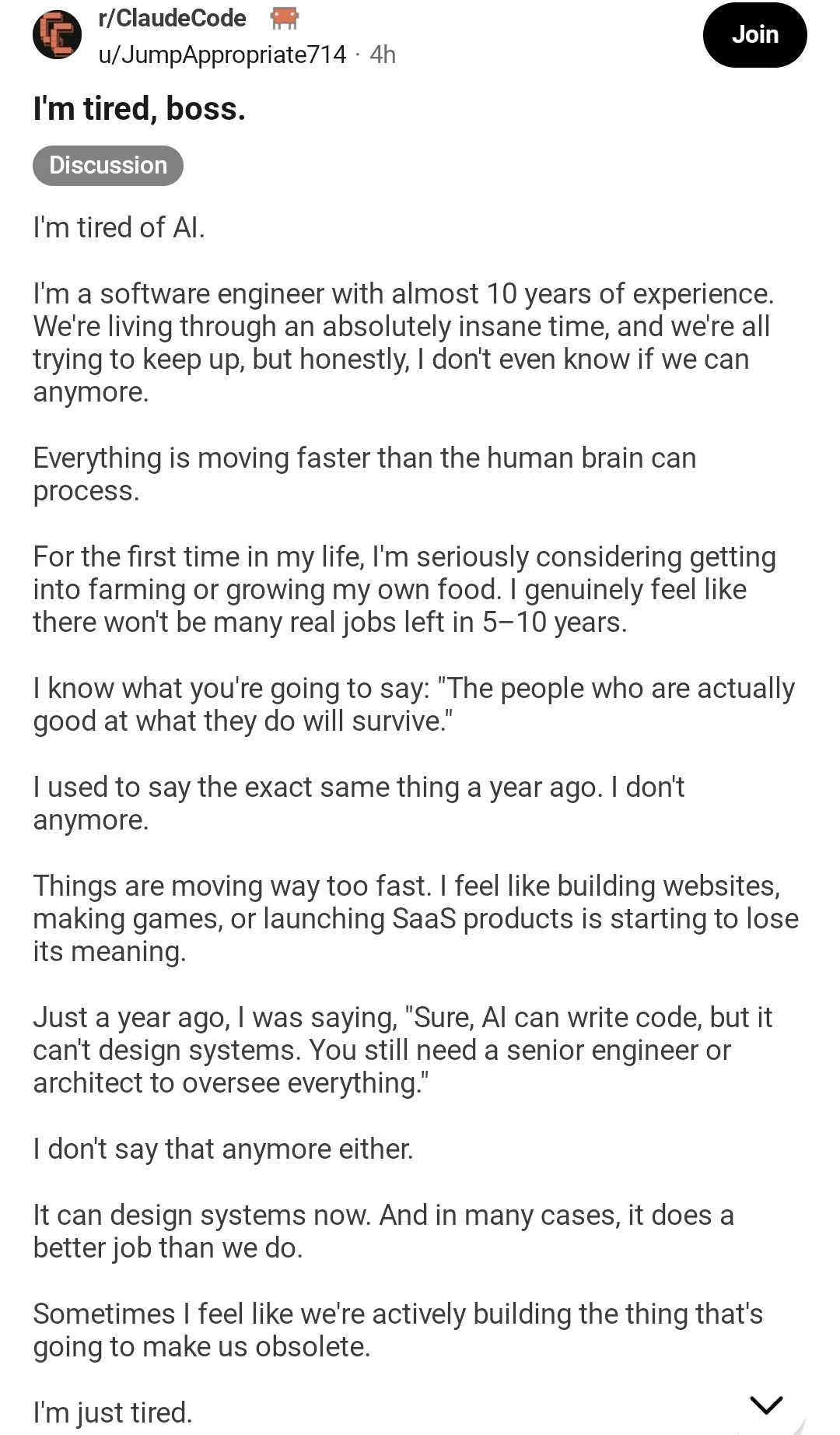
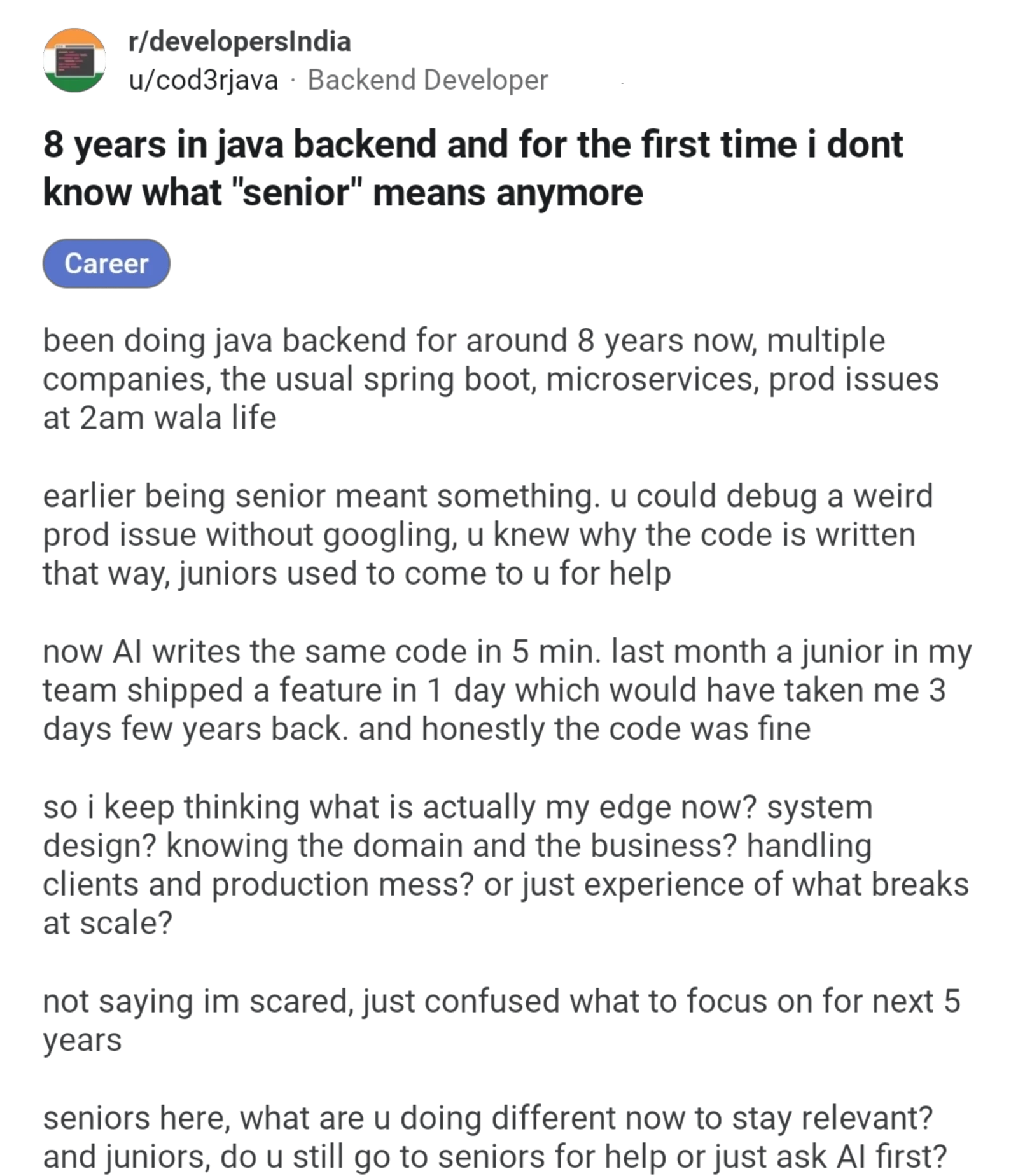
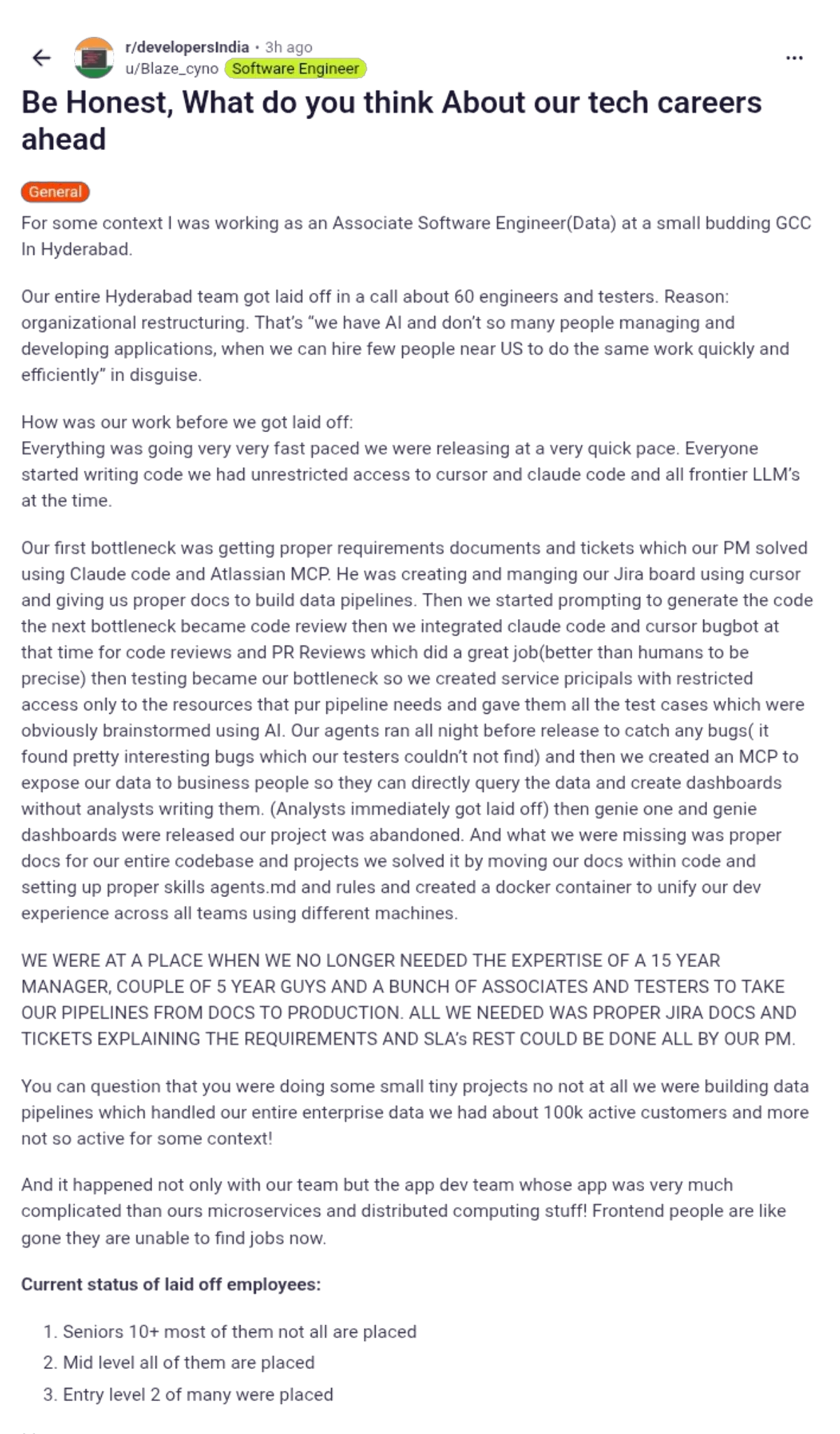
Normally, if you get fired, you can still find a similar job in a different company. It is a different story when your entire profession is wiped out. It is a radically different story when entire categories of knowledge work are wiped out - you can’t even work in an adjacent industry.

The displaced are the people who end up having nothing to eat. A colossal number of such people. Historically, once your country has masses of people struggling to fulfil basic human needs, attempts to overturn the government follow.
To avoid anarchy and collapse, the simple routes are few:
- Print/borrow money to subsidise the displaced ones
- Establish an authoritarian regime and heavily suppress resistance
The first and second are, respectively, economically and politically unsustainable in the long term. Both are suboptimal.
I believe there must be a way for the UK and other first-world countries to go through the transition with only a minimal amount of radicalism. Although, the solution will likely not be simple - it will involve taking a range of decisive actions.
That’s where having a strong leadership in the government becomes central to the future prosperity of the nation.
It’s not impossible that we are going through the last and most decisive era of human-only governance.
Sources: